
18 Iconic NYC Landmarks You Must Visit
New York City is home to some of the most iconic NYC landmarks to visit anywhere in the world, and having been here more times than I can count, I can tell you it never gets old.
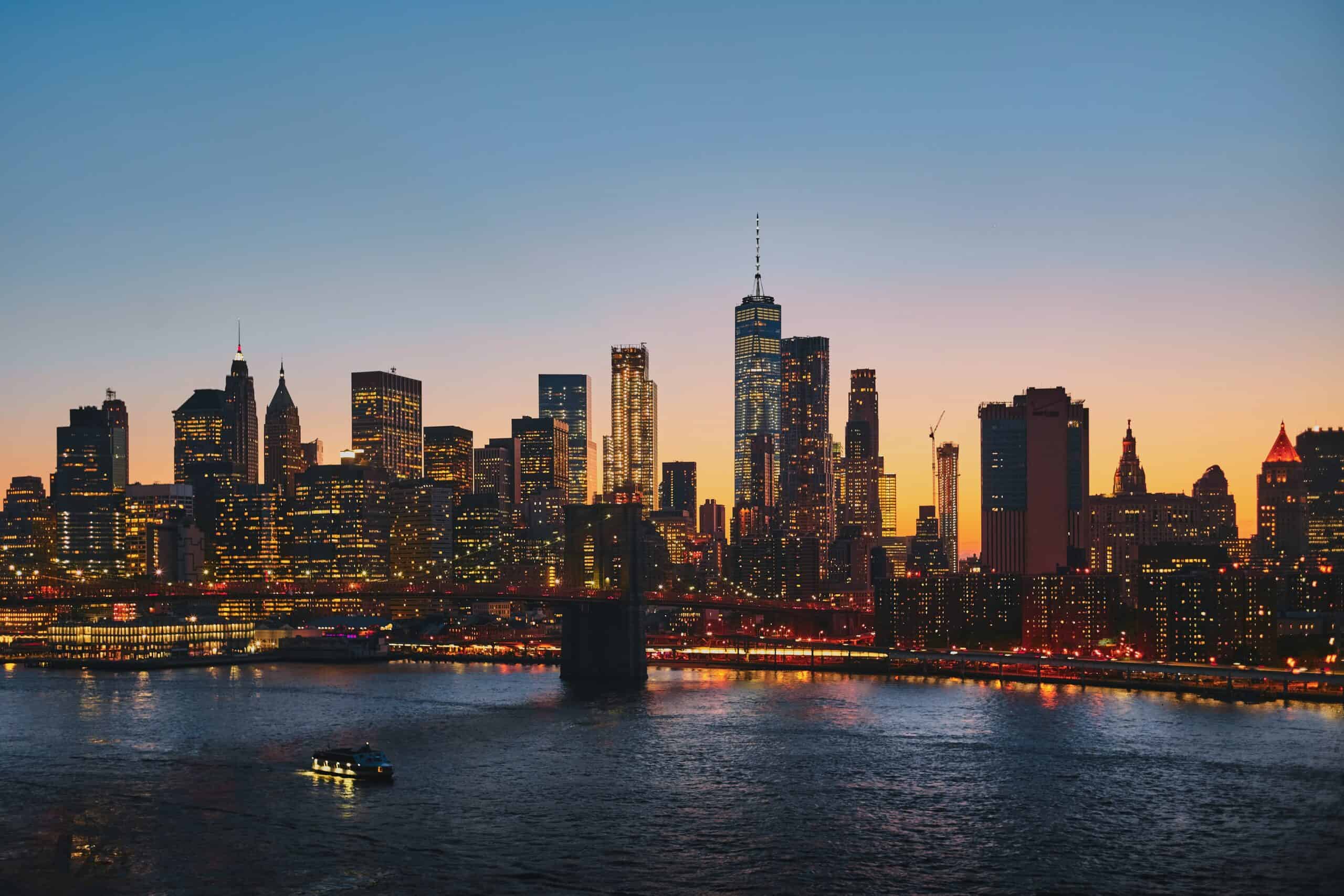
The skyline alone stops you in your tracks every single time, whether you’re seeing it for the first time from the Brooklyn Bridge or the hundredth time from a cab crossing into Manhattan.
New York is my favorite city in North America, and the West Village and SoHo are two of my favorite places to spend time anywhere in the world.
There’s an energy here that you simply can’t replicate, and no matter how many times you visit, the city always finds a way to surprise you.
Part of what makes New York so compelling is that its most iconic landmarks aren’t just tourist checkboxes. They’re living, functioning parts of a city that 8 million people call home.
Central Park isn’t a museum piece, it’s where New Yorkers actually go on weekends. The subway isn’t a novelty, it’s how people get to work. Even Times Square, as chaotic and commercial as it is, means something to the fabric of what this city is.
If you’re putting together your first visit or planning your next one, make sure you check out the full New York City bucket list for everything worth doing beyond the landmarks themselves.
But if you’re starting with the icons, and you should, here are 18 NYC landmarks that deserve to be on every visitor’s list.
Central Park
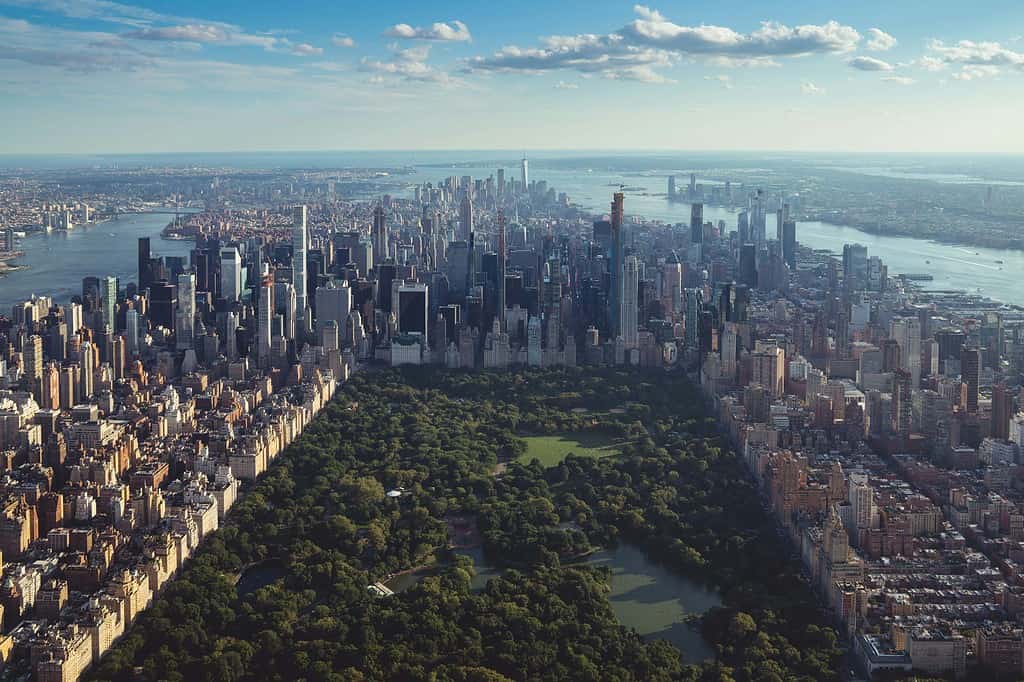
There is no landmark more central to New York City’s identity than Central Park, and visiting it in person makes it immediately clear why.
843 acres of green space sitting in the middle of one of the densest urban environments on earth. It shouldn’t work. It does, completely.
The park is different things to different people. Joggers circle the reservoir at dawn. Families spread out on the Great Lawn on weekends.
Street musicians set up near Bethesda Fountain. Rowboats drift across the lake. Horse-drawn carriages move slowly along the perimeter roads.
In winter, Wollman Rink turns into one of the most scenic ice skating spots in the world with the Midtown skyline rising behind it.
In spring, the cherry blossoms around the reservoir draw crowds that make you feel like you’ve stumbled into a painting.
The best way to experience Central Park is to simply walk into it without an agenda. Enter from the south near Columbus Circle, head north, and let the park unfold.
You’ll find Shakespeare Garden, the Strawberry Fields memorial for John Lennon, Belvedere Castle, and more hidden corners than a single visit can cover.
The Brooklyn Bridge

The Brooklyn Bridge is one of the most beautiful pieces of engineering in the world, and walking across it is one of the best free experiences New York has to offer.
Completed in 1883, it was the longest suspension bridge in the world at the time of its construction.
The Gothic stone towers, the steel cable web, and the views of the Manhattan skyline and the East River from the elevated pedestrian walkway are genuinely breathtaking.
Walk from Brooklyn toward Manhattan in the morning for the best light. The skyline ahead of you, the bridge structure framing everything, it’s one of those views that you’ve seen in a thousand photos and still somehow exceeds expectations in person.
Allow about 30-40 minutes to walk the full crossing at a comfortable pace. The pedestrian path runs above the vehicle lanes, so you’re elevated and unobstructed.
DUMBO on the Brooklyn side is worth exploring before or after the crossing, good coffee, excellent restaurants, and the iconic view of the bridge framed between the buildings on Washington Street.
Times Square
Times Square is chaotic, commercial, overwhelming, and not particularly representative of what makes New York great. It’s also completely unmissable.
There is nowhere else on earth that looks or feels like Times Square. The density of neon, LED, and digital signage.
The crowds at all hours. The energy that doesn’t stop regardless of the time of day or night. It’s an assault on the senses in the most New York way possible.
Go at least once, preferably at night when the lights are at full intensity. Walk through it, take it in, and then get out.
It’s not a place to linger for hours, but it is a place that deserves to be experienced firsthand rather than written off from a distance.
The best version of Times Square is from above, the TKTS booth steps give you an elevated perspective on the whole spectacle that’s worth the brief climb.
The Statue of Liberty
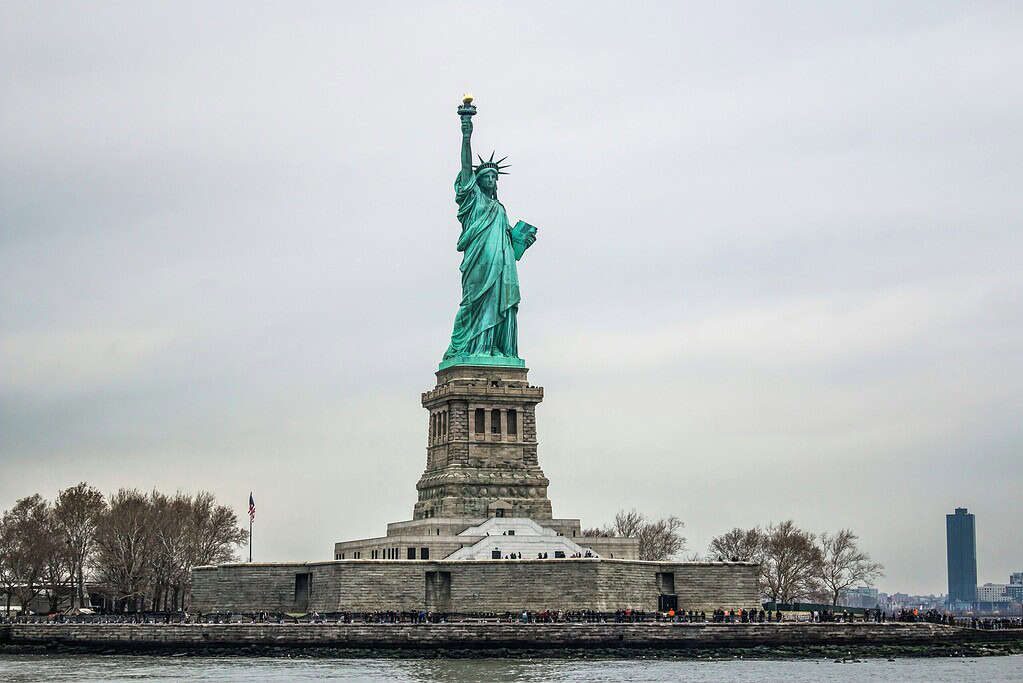
The Statue of Liberty is one of the most recognized symbols in the world, and seeing it in person is a different experience from any photo or film representation.
Lady Liberty stands 305 feet tall from ground to torch on Liberty Island in New York Harbor. She was a gift from France, completed in 1886, and has served as a symbol of freedom and welcome for generations of immigrants arriving by sea.
Getting there requires a ferry from Battery Park in Lower Manhattan or Liberty State Park in New Jersey.
Book tickets in advance, the ferry sells out, especially in peak season. Tickets to the pedestal and crown require even earlier booking, sometimes months ahead.
Even if you only do the grounds tour without going inside, standing at the base of the statue and looking up is worth the trip.
The views of the Manhattan skyline from Liberty Island are also among the best you’ll find anywhere in the harbor.
The Empire State Building
The Empire State Building is New York’s most iconic skyscraper, and the view from the observation deck remains one of the best in the city despite the newer, taller options that have opened in recent years.
Completed in 1931, it held the title of world’s tallest building for over 40 years. The Art Deco design is still stunning, and the building’s distinctive silhouette defines the Midtown skyline in a way that no other structure quite does.
The 86th floor observation deck is the classic choice, open air, 360-degree views, and that specific altitude that makes Manhattan feel comprehensible for the first time. The 102nd floor top deck adds height but removes the outdoor element.
Go at sunset or in the evening for the most dramatic views. Book tickets online in advance to skip the lines, which can be brutal during peak season.
New York Public Library

The New York Public Library on Fifth Avenue is one of the most beautiful Beaux-Arts buildings in the United States, and most visitors walk right past it without going inside.
Built in 1911, the main branch on 42nd Street and Fifth Avenue is officially named the Stephen A. Schwarzman Building, though most New Yorkers just call it the library.
The exterior alone is worth stopping for, flanked by two marble lion sculptures nicknamed Patience and Fortitude, the facade is one of the most photographed in Midtown.
But the interior is where it genuinely earns its place on this list. The Rose Main Reading Room on the third floor is 297 feet long with 52-foot ceilings, gilded chandeliers, and a painted ceiling that makes it one of the grandest public rooms in New York. It’s free to enter. Anyone can walk in off the street and sit down.
The library also regularly hosts exhibitions covering art, history, and culture that are open to the public at no charge.
It’s two blocks from Bryant Park and directly adjacent to the 42nd Street subway hub, making it one of the easiest landmarks on this list to incorporate into a full day in Midtown.
One World Trade Center & The 9/11 Memorial

One World Trade Center and the 9/11 Memorial occupy one of the most emotionally significant pieces of ground in America, and visiting requires a different kind of attention than most tourist experiences.
The two memorial pools sit in the exact footprints of the original Twin Towers, 30-foot waterfalls cascading into reflecting pools with the names of the 2,977 victims inscribed around the edges. It’s a powerful and quietly devastating design that earns its space.
One World Trade, now the tallest building in the Western Hemisphere, rises directly adjacent.
The One World Observatory on floors 100-102 offers extraordinary views and a sophisticated visitor experience.
The 9/11 Memorial Museum underground is an extensive, deeply researched account of the attacks and their context. It’s not easy to get through, but it’s important and exceptionally well done.
Allow at least half a day for this area. The weight of it deserves more than a quick stop.
Grand Central Terminal
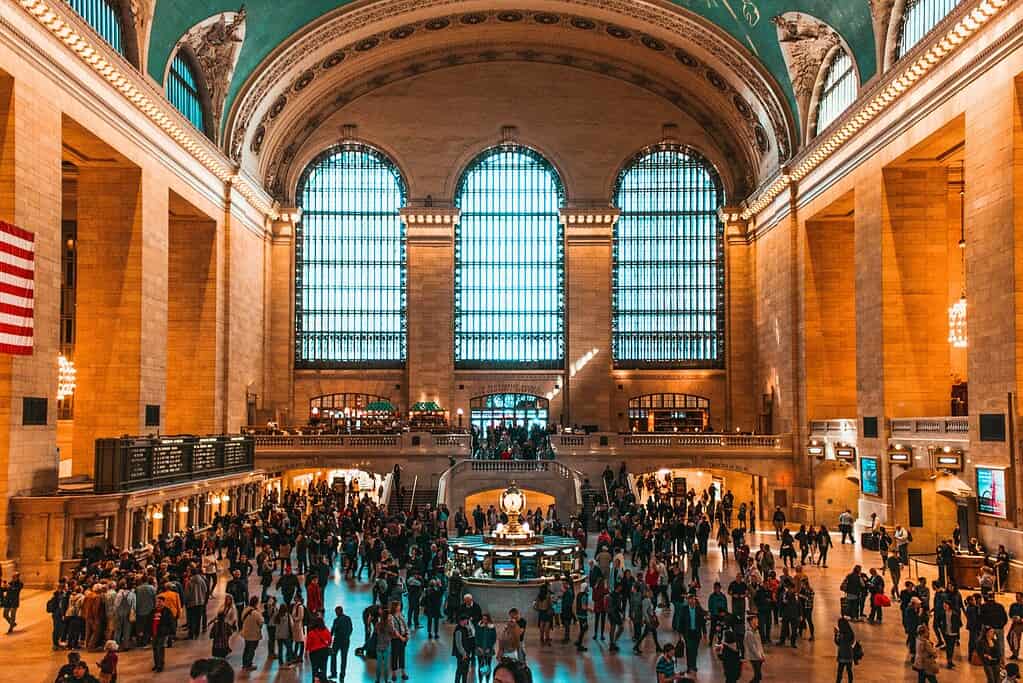
Grand Central Terminal is one of the most beautiful buildings in New York, and most visitors walk through it without fully appreciating what they’re looking at.
The main concourse ceiling is painted with a turquoise astronomical mural depicting the winter sky constellations, it covers 12,000 square feet and has been there, in various states of restoration, since 1912.
The light that falls through the tall arched windows across the main hall at certain times of day is extraordinary.
More than 750,000 people pass through Grand Central daily, making it one of the busiest transit hubs in the world.
And yet the architecture manages to make that feel dignified rather than chaotic.
Eat at one of the restaurants in the dining concourse below. Stand in the main hall and look up.
Visit the Whispering Gallery near the Oyster Bar, where the curved walls carry whispered sounds across the space in a way that feels almost supernatural. It’s a train station. It’s also one of the finest rooms in America.
The Metropolitan Museum of Art
The Met is one of the greatest art museums in the world, and a single visit barely scratches the surface of what it holds.
More than two million works spanning 5,000 years of human history. Egyptian temples. European old masters.
American decorative arts. Asian galleries. Greek and Roman sculpture. Arms and armor. The Costume Institute. The rooftop garden with seasonal installations and views of Central Park.
The Met sits directly on Fifth Avenue along the edge of Central Park, which makes combining a museum visit with a park walk one of the better half-days you can spend in New York.
The suggested admission is around $30 for adults, but it is suggested, you can technically pay what you want. Go early to avoid crowds in the most popular galleries.
Don’t try to see everything. Pick two or three sections that genuinely interest you and spend real time there. The museum rewards focus over sprint.
Rockefeller Center & Top of the Rock

Rockefeller Center is a 19-building complex in Midtown Manhattan that functions simultaneously as a working business hub, a tourist destination, a historic Art Deco landmark, and a genuine piece of New York cultural life.
The ice rink in the sunken plaza in front of 30 Rock is one of the most iconic winter images in American culture.
The Today Show broadcasts from the street-level studio. Radio City Music Hall hosts the Rockettes every Christmas season. NBC Studios runs tours.
Top of the Rock, the observation deck on floors 67-70 of 30 Rockefeller Plaza, offers some of the best views in the city, specifically because you can see the Empire State Building from here, which you can’t from the Empire State Building itself. The three-level deck gives you both enclosed and open-air viewing options.
Madison Square Garden
Madison Square Garden is the most famous arena in the world, and its nickname, The World’s Most Famous Arena, isn’t marketing. It’s just accurate.
Sitting directly above Penn Station at 34th Street and Seventh Avenue, MSG has hosted everything from championship boxing matches to Rolling Stones concerts to NBA Finals games to political conventions.
If something significant has happened in American entertainment or sports over the last century, there’s a decent chance it happened here.
The current building, the fourth to carry the Madison Square Garden name, opened in 1968 and has been renovated multiple times since. The circular design is instantly recognizable on the Manhattan skyline even if you don’t know what you’re looking at.
Catching a Knicks or Rangers game here is one of the classic New York experiences. The atmosphere in the building during a playoff game is unlike anything else in the city.
But even a concert or non-sports event carries the weight of the venue’s history in a way that’s genuinely felt.
Tours of the arena run regularly if you want access without buying event tickets, they cover the locker rooms, the court, and the historical exhibits tracking the building’s remarkable legacy.
The Chrysler Building
The Chrysler Building is arguably the most beautiful skyscraper in New York City, and it doesn’t get nearly the attention it deserves compared to its neighbors.
Completed in 1930 at 77 floors and 1,046 feet, it held the title of world’s tallest building for eleven months before the Empire State Building surpassed it.
The Art Deco design, particularly the stainless steel eagle gargoyles at the 61st floor and the distinctive tiered crown, remains one of the finest examples of 20th-century architecture anywhere in the world.
The crown is best appreciated from a distance. The view from the Top of the Rock or the Empire State Building observation deck gives you a clean sightline to the Chrysler’s iconic sunburst top that most visitors don’t think to look for.
The lobby is open to the public during business hours and is worth a brief visit, the ceiling mural depicting transportation and industry, the amber-lit walls, and the original elevator doors are all original 1930 details that have been carefully preserved.
It doesn’t have an observation deck, which is part of why it gets overlooked. But as a piece of architecture to look at and appreciate, nothing in Midtown touches it.
The Flatiron Building
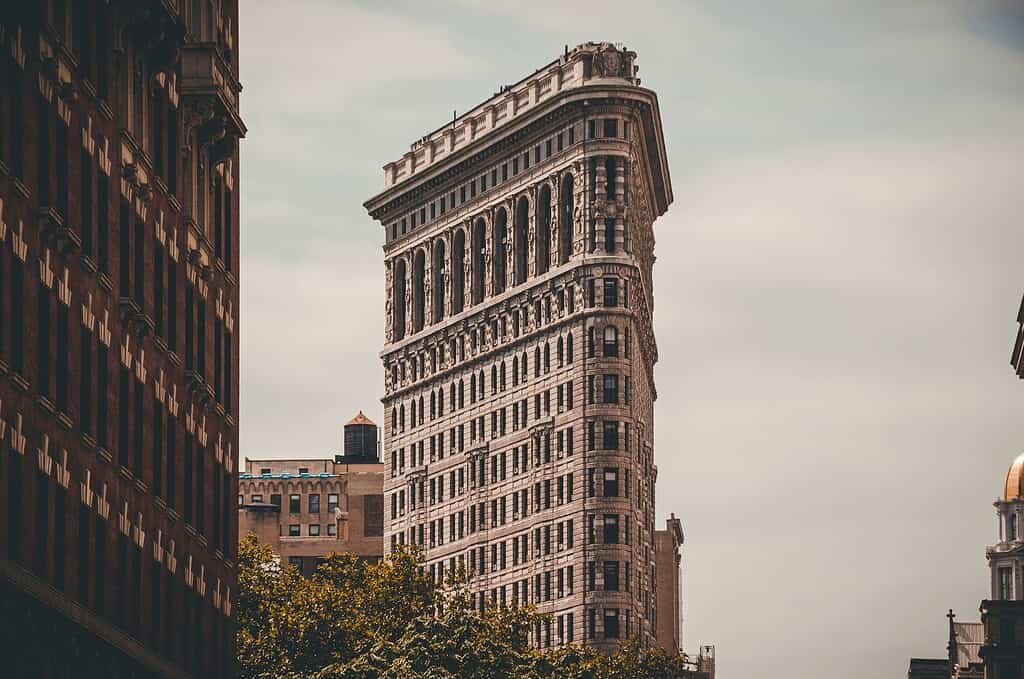
The Flatiron Building is one of New York’s most photographed structures and one of the earliest skyscrapers ever built, completed in 1902 at the triangular intersection of Fifth Avenue and Broadway at 23rd Street.
The building’s unusual wedge shape, sometimes as narrow as six feet at its northern tip, was a product of the awkward lot it was built on rather than an architectural statement. The result, however, is one of the most distinctive building profiles in the world.
The Flatiron District surrounding it has developed into one of Manhattan’s better neighborhoods for restaurants and shops, and Madison Square Park directly across the street is one of the nicest small parks in the city.
You can’t go inside as a tourist, but photographing it from the park or from the various angles where the narrow edge is visible is worth spending a few minutes on.
The Oculus at World Trade Center

The Oculus is the transportation hub and shopping center that sits adjacent to the 9/11 Memorial, and it’s one of the most striking pieces of contemporary architecture in New York.
Designed by Santiago Calatrava, the white steel structure resembles a bird in flight, or a dove with outstretched wings, depending on who you ask.
Inside, the main hall is an enormous white ribbed atrium that floods with natural light through a retractable skylight.
It’s free to enter and worth at least a brief visit purely for the architecture. The Oculus connects the PATH train to New Jersey with the MTA subway lines and several buildings in Lower Manhattan’s Brookfield Place complex.
Coney Island
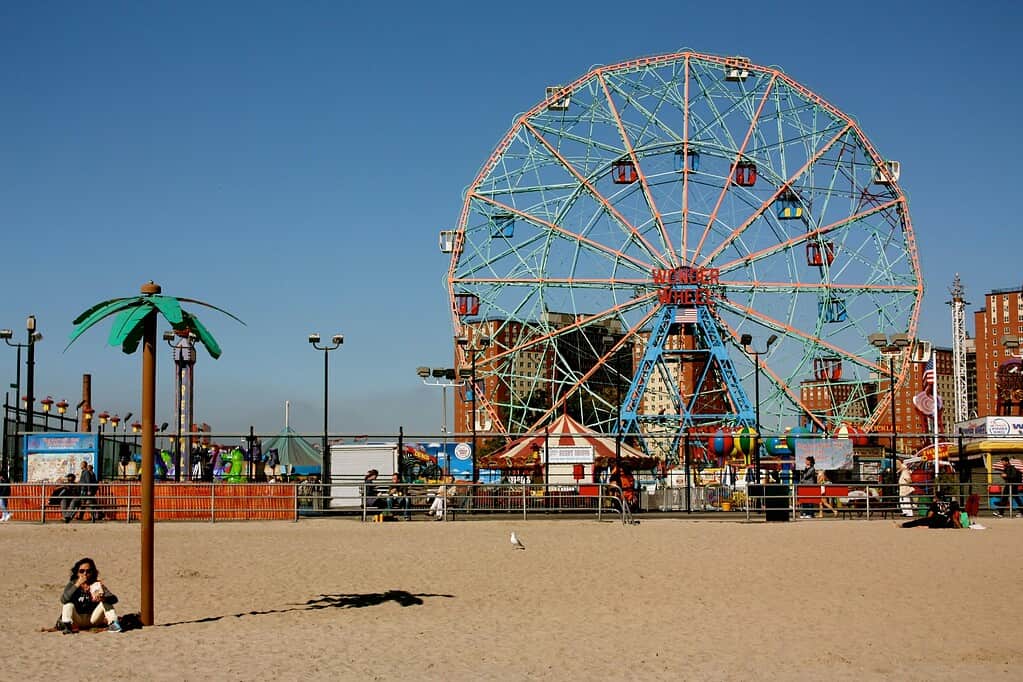
Coney Island sits at the southern tip of Brooklyn, and it’s one of those New York places that feels completely unlike the rest of the city.
A historic amusement park, a boardwalk, a beach, and a collection of old-school carnival attractions and food vendors that have been operating in various forms since the late 1800s.
The Cyclone wooden roller coaster dates to 1927 and is a landmark in its own right.
Nathan’s Famous hot dog stand on Surf Avenue has been serving the same product since 1916 and is as much a New York institution as anything in Manhattan.
Take the D, F, N, or Q train from Manhattan, it’s about an hour from Midtown and a world away in feel.
Go in summer for the full experience. Go on a weekday if possible to avoid the largest crowds.
Broadway and the Theater District
Broadway isn’t a single building or a single block, it’s a cultural institution that defines New York in a way that nothing else quite does.
The Theater District runs roughly from 41st to 54th Street along and around Broadway and Seventh Avenue in Midtown, and it contains the highest concentration of world-class live theater anywhere on earth.
On any given night, dozens of shows are running simultaneously across Broadway and Off-Broadway venues, from long-running musicals to new dramatic productions to revivals that attract the biggest names in entertainment.
Seeing a Broadway show is one of those New York experiences that sounds like a tourist cliché until you’re actually sitting in one of those historic theaters watching a live performance at the level Broadway demands, and then it becomes obvious why people plan entire trips around it.
TKTS in Times Square sells same-day discount tickets for many shows at up to 50% off, which makes Broadway significantly more accessible than most people assume. Lining up early gives you the best selection.
The theaters themselves are worth paying attention to architecturally. The Majestic, the St. James, the Shubert, the Lyceum, many date to the early 20th century and have interiors that are as worth experiencing as the shows being performed inside them.
The Guggenheim Museum
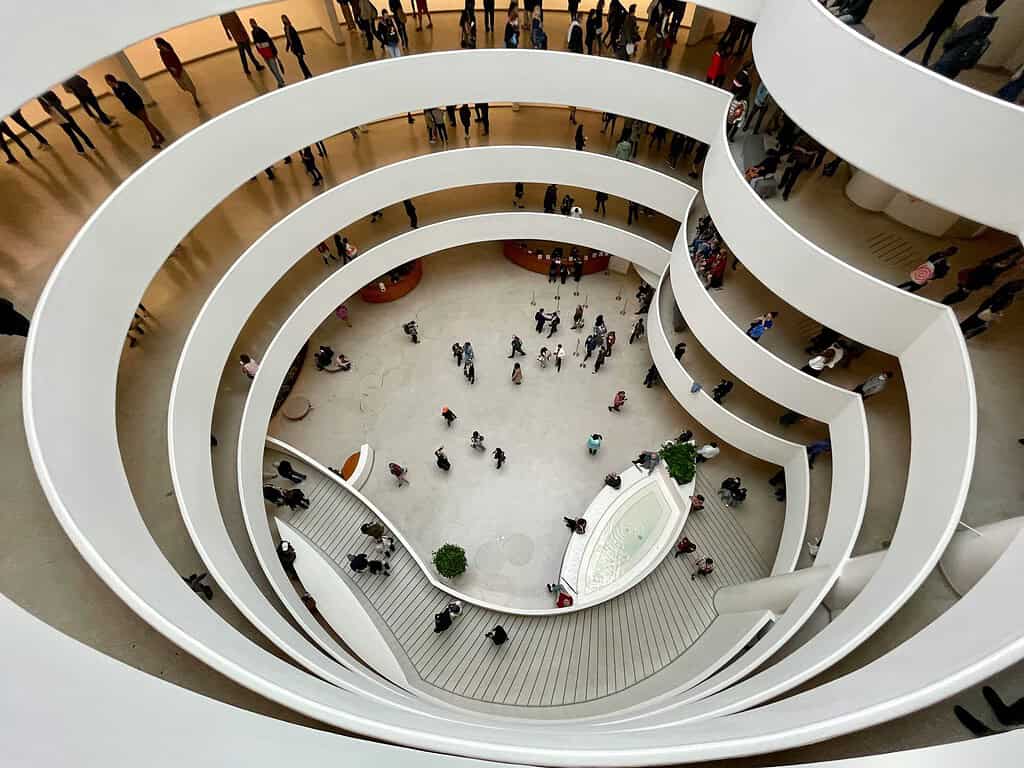
The Guggenheim is as much a landmark for its building as for its collection, and that’s not a criticism, it’s genuinely one of the most remarkable pieces of architecture in America.
Frank Lloyd Wright’s spiraling cylindrical design opened in 1959 and remains one of the defining buildings of 20th-century architecture.
The continuous spiral ramp running from ground floor to skylight creates a unified exhibition space that allows you to experience the collection in a single fluid movement rather than room by room.
The permanent collection focuses on Impressionist, Post-Impressionist, early Modern, and contemporary work. The rotating exhibitions on the ramp are typically world-class.
It sits on Fifth Avenue’s Museum Mile at 88th Street, which puts it alongside the Met and a cluster of other significant museums within walking distance.
Final Thoughts on NYC Landmarks
New York doesn’t ask you to rank its landmarks. It just asks you to show up.
Every single thing on this list is worth your time, whether you’re visiting for the first time or the fifteenth.
The city has a way of making even familiar landmarks feel fresh depending on the season, the time of day, or simply the mood you bring with you.
If you’re building your itinerary around these 18 spots, give yourself more time than you think you need.
New York City rewards the visitor who slows down enough to actually absorb what they’re looking at.
And when you’re done with the landmarks, the real city is waiting, in the side streets, the bodegas, the neighborhood restaurants, and the subway rides that take you somewhere you didn’t plan to go. That’s where New York actually lives. Make sure you find it.

What is the most iconic landmark in NYC?
Central Park, the Brooklyn Bridge, and the Statue of Liberty are the three strongest arguments. Central Park defines the heart of Manhattan, the Brooklyn Bridge is the most recognizable structure in the city, and the Statue of Liberty is the most globally recognized symbol America has.
How many days do you need to see NYC’s main landmarks?
Four to five days is realistic without rushing. Some landmarks like the 9/11 Memorial and the Met deserve half a day each, while others like the Flatiron Building, Grand Central, and the Public Library can be combined into a single walking day.
Are NYC landmarks expensive to visit?
It varies. Central Park, the Brooklyn Bridge, the Flatiron Building, and the Public Library are completely free.
The Empire State Building, Top of the Rock, and the Statue of Liberty ferry run $25-45 USD. Book online in advance to skip lines and occasionally save money.
What’s the best NYC landmark to visit first?
The Brooklyn Bridge walk is the best introduction to the city. It’s free, gives you the Manhattan skyline head-on, and takes about 30-40 minutes.
Start from the Brooklyn side for the best views walking toward Manhattan.
